


Welcome to the engine room of Base44.com. Our backend is the invisible powerhouse that drives every feature, every interaction, and every piece of data you trust us with. It’s where complex server-side logic meets elegant engineering to create a seamless user experience. In this deep dive, we pull back the curtain on the Base44.com backend, exploring the principles, technologies, and architecture that make our platform fast, reliable, and secure. We are passionate about world-class backend development, and we invite you to explore the core of what makes our system tick. Discover the decisions and strategies that empower our platform to perform at scale and prepare for the challenges of tomorrow.
- The Guiding Principles of Our Backend Philosophy
- Unpacking the Base44.com Technology Stack
- Core Programming Languages and Why We Chose Them
- Key Frameworks That Accelerate Our Development
- Our Approach to Microservices Architecture
- Database Strategy: How We Manage Data at Scale
- A Hybrid SQL and NoSQL Implementation
- Data Replication and Sharding for Resilience
- The Central Role of APIs in the Base44.com Ecosystem
- Building a Robust Cloud Infrastructure
- DevOps in Action: Our CI/CD and Automation Pipeline
- Containerization Explained: Using Docker and Kubernetes
- Strategies for Maximum Uptime and System Reliability
- Scaling the Backend to Handle Peak Demand
- Performance Tuning and Advanced Caching Layers
- A Deep Dive into Our Backend Security Measures
- Protecting User Data with End-to-End Encryption
- Real-Time Monitoring, Logging, and Alerting Systems
- Key Technical Challenges and How We Solved Them
- The Future Roadmap for the Base44.com Backend
- Frequently Asked Questions
The Guiding Principles of Our Backend Philosophy
Every line of code we write and every system we design is guided by a core set of principles. This philosophy ensures consistency, quality, and a focus on what truly matters for our users and developers. Our approach to backend development is built on these foundational pillars:
- Performance is Paramount: We treat speed as a critical feature. Slow systems frustrate users and limit growth. Our server-side logic is optimized for rapid response times and efficient resource utilization.
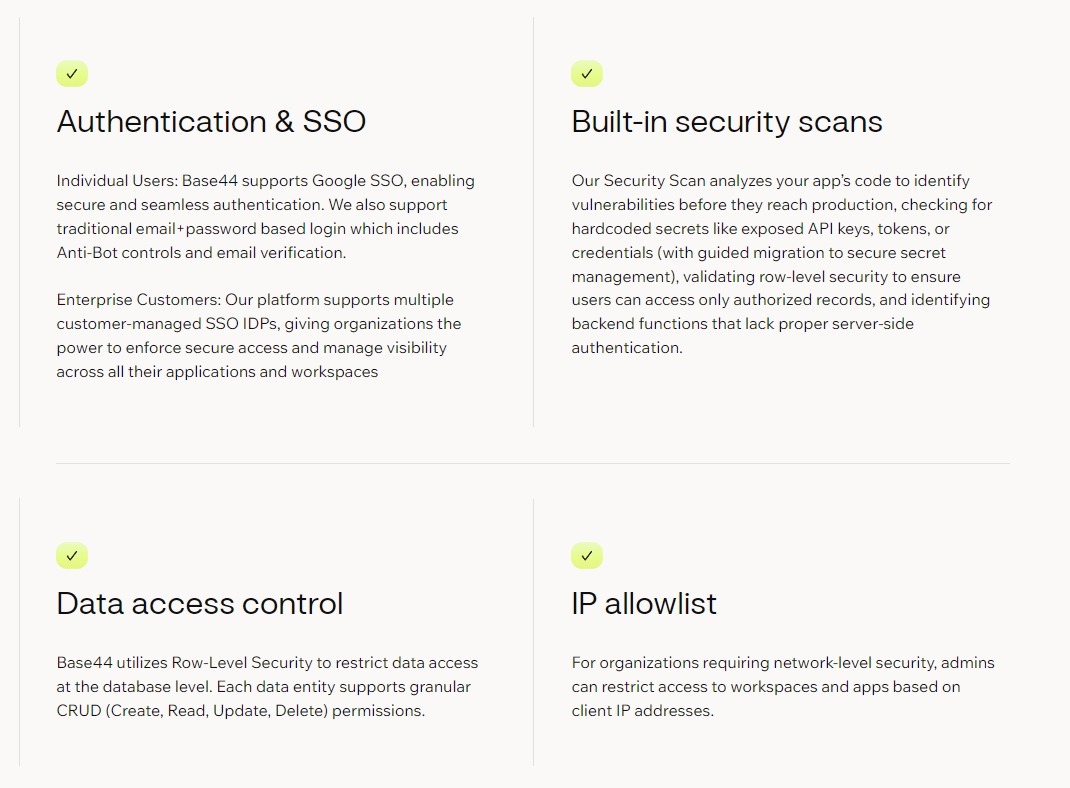
- Security by Design: We do not add security as an afterthought. It is a fundamental requirement woven into every layer of our architecture, from API integration to database management.
- Build for Scale: We anticipate growth. Our systems are designed from the ground up to handle massive increases in traffic and data without compromising performance or stability.
- Simplicity Over Complexity: We believe the best solution is often the simplest one. We write clear, maintainable code and design straightforward systems that are easy to understand, debug, and evolve.
- Automate Everything: We empower our engineers by automating repetitive tasks. This minimizes human error, accelerates development cycles, and frees our team to focus on solving meaningful problems.
Unpacking the Base44.com Technology Stack
A technology stack is the collection of software, tools, and languages we use to build and run the Base44.com backend. Choosing the right stack is crucial for building a high-performing and maintainable platform. Our choices reflect our commitment to using modern, proven, and powerful tools that are best suited for the specific challenges we face. We believe in using the right tool for the right job, resulting in a polyglot stack that gives us flexibility and power. In the following sections, we will break down the key components of our backend development ecosystem, from the programming languages that form our foundation to the frameworks that help us build faster.

Core Programming Languages and Why We Chose Them
The choice of a programming language has a profound impact on performance, scalability, and developer productivity. We leverage a carefully selected set of languages, each chosen for its specific strengths in our backend development environment.
| Language | Primary Use Case | Reasoning |
|---|---|---|
| Go (Golang) | High-concurrency microservices and API gateways. | Exceptional performance, built-in concurrency support, and simple syntax make it ideal for building fast, reliable, and scalable server-side logic. |
| Python | Data analysis, machine learning models, and automation scripts. | Its extensive library ecosystem, readability, and rapid development capabilities make it perfect for complex data processing and operational tooling. |
| TypeScript (on Node.js) | Real-time applications, such as notifications and live updates. | Its non-blocking, event-driven architecture excels at handling numerous simultaneous connections, essential for interactive features. |
Key Frameworks That Accelerate Our Development
Frameworks provide a structure and a set of tools that allow our engineers to build robust server-side logic without reinventing the wheel. They enforce best practices and handle common tasks, enabling us to focus on creating unique features for Base44.com.
- Gin (for Go): A minimalistic yet incredibly fast web framework. We use Gin to build high-performance REST APIs, leveraging its speed and low overhead to serve requests with minimal latency.
- FastAPI (for Python): A modern, high-performance web framework for building APIs. Its automatic interactive documentation and type-hinting features improve developer experience and reduce bugs in our API integration processes.
- Express.js (for Node.js): A flexible and unopinionated framework that serves as the foundation for our real-time services. It gives us the freedom to design custom solutions while providing a stable base for handling web traffic.
Our Approach to Microservices Architecture
We build the Base44.com backend using a microservices architecture. Instead of creating one large, monolithic application, we build our system as a collection of small, independent services. Each service is responsible for a single business function, such as user authentication or payment processing. This approach provides incredible benefits.
“Microservices give us the agility to innovate quickly and the resilience to operate reliably. We can update, deploy, and scale individual parts of our application without affecting the entire system.”
This architectural style allows different teams to work on different services simultaneously, using the technology best suited for their specific task. It also improves fault isolation; if one service experiences an issue, it doesn’t bring down the entire platform. This is a core component of how we deliver a stable and constantly evolving product.
Database Strategy: How We Manage Data at Scale
Data is the lifeblood of Base44.com. Our database strategy is designed to ensure data is stored securely, accessed quickly, and managed efficiently, even as our user base grows exponentially. We embrace a concept known as “polyglot persistence.” This simply means we don’t believe in a one-size-fits-all database solution. Instead, we use multiple database technologies, selecting the perfect one for each specific job. This flexible approach to database management allows us to optimize every aspect of our platform, from transactional integrity to real-time analytics, ensuring the right data structure for the right task.
A Hybrid SQL and NoSQL Implementation
Our database management strategy hinges on a powerful hybrid model that combines the strengths of both SQL and NoSQL databases. This allows us to handle diverse data types and access patterns with maximum efficiency.
- SQL (PostgreSQL)
- We rely on PostgreSQL for our core transactional data. This includes user accounts, billing information, and any data that requires strict consistency and integrity. Its relational structure and ACID compliance guarantee that our most critical data is always safe and accurate.
- NoSQL (Redis & MongoDB)
- For data that requires high speed and flexibility, we turn to NoSQL. We use Redis as a high-speed in-memory cache for session management and real-time leaderboards. MongoDB is used for storing large volumes of unstructured data, like user-generated content and activity logs, where its flexible schema and horizontal scalability shine.
Data Replication and Sharding for Resilience
To ensure our database systems are both highly available and performant, we employ two key techniques: replication and sharding. These strategies form the backbone of our resilient database management.
- Replication: We create and maintain multiple copies of our data across different servers in real-time. If the primary database server fails, a replica is automatically promoted to take its place with no data loss and minimal downtime. This provides crucial redundancy and disaster recovery capabilities.
- Sharding: As our datasets grow, we horizontally partition them by splitting a large database into smaller, more manageable pieces called shards. Each shard contains a subset of the data and can be located on a separate server. This distributes the load, dramatically improving query performance and allowing us to scale our database capacity almost infinitely.
The Central Role of APIs in the Base44.com Ecosystem
Application Programming Interfaces (APIs) are the connective tissue of the Base44.com backend. They are the contracts that define how our hundreds of microservices communicate with each other and how our mobile and web applications interact with the server-side logic. We operate on an “API-first” principle. This means every new feature begins with a carefully designed API, ensuring clear communication and seamless integration across the entire platform. Our ecosystem leverages both RESTful APIs for standard client-server communication and GraphQL for more complex scenarios where clients need the flexibility to request exactly the data they need, and nothing more. This robust approach to API integration is fundamental to our agility and scalability.
Building a Robust Cloud Infrastructure
The entire Base44.com backend runs on a modern, cloud-native infrastructure. We intentionally avoid managing physical hardware, instead leveraging the power and flexibility of a leading cloud provider. This allows us to focus on writing great code and building features, not on racking servers. Our infrastructure is built for elasticity and resilience, using a suite of managed services that provide scale and reliability. Key components include elastic compute instances that automatically scale with traffic, managed database services that handle backups and failover, global object storage for media assets, and a Content Delivery Network (CDN) that ensures users worldwide experience fast load times by serving content from a location near them.
DevOps in Action: Our CI/CD and Automation Pipeline
We believe that the speed and reliability of our backend development are directly tied to the quality of our automation. We practice a strong DevOps culture centered around a sophisticated Continuous Integration and Continuous Deployment (CI/CD) pipeline. This automated workflow transforms how we deliver code.
- Commit: A developer pushes new code to our central repository.
- Build & Test: The CI system automatically triggers, compiling the code and running a comprehensive suite of unit, integration, and security tests.
- Deploy: If all tests pass, the CD system automatically deploys the new code to a staging environment for final validation before promoting it to production with zero downtime.
This pipeline allows us to release updates multiple times a day with high confidence, reducing risk and accelerating the pace of innovation for the Base44.com backend.
Containerization Explained: Using Docker and Kubernetes
Consistency and scalability are paramount in our server-side logic deployment. We achieve this through containerization, a technology that has revolutionized how we build and run software.
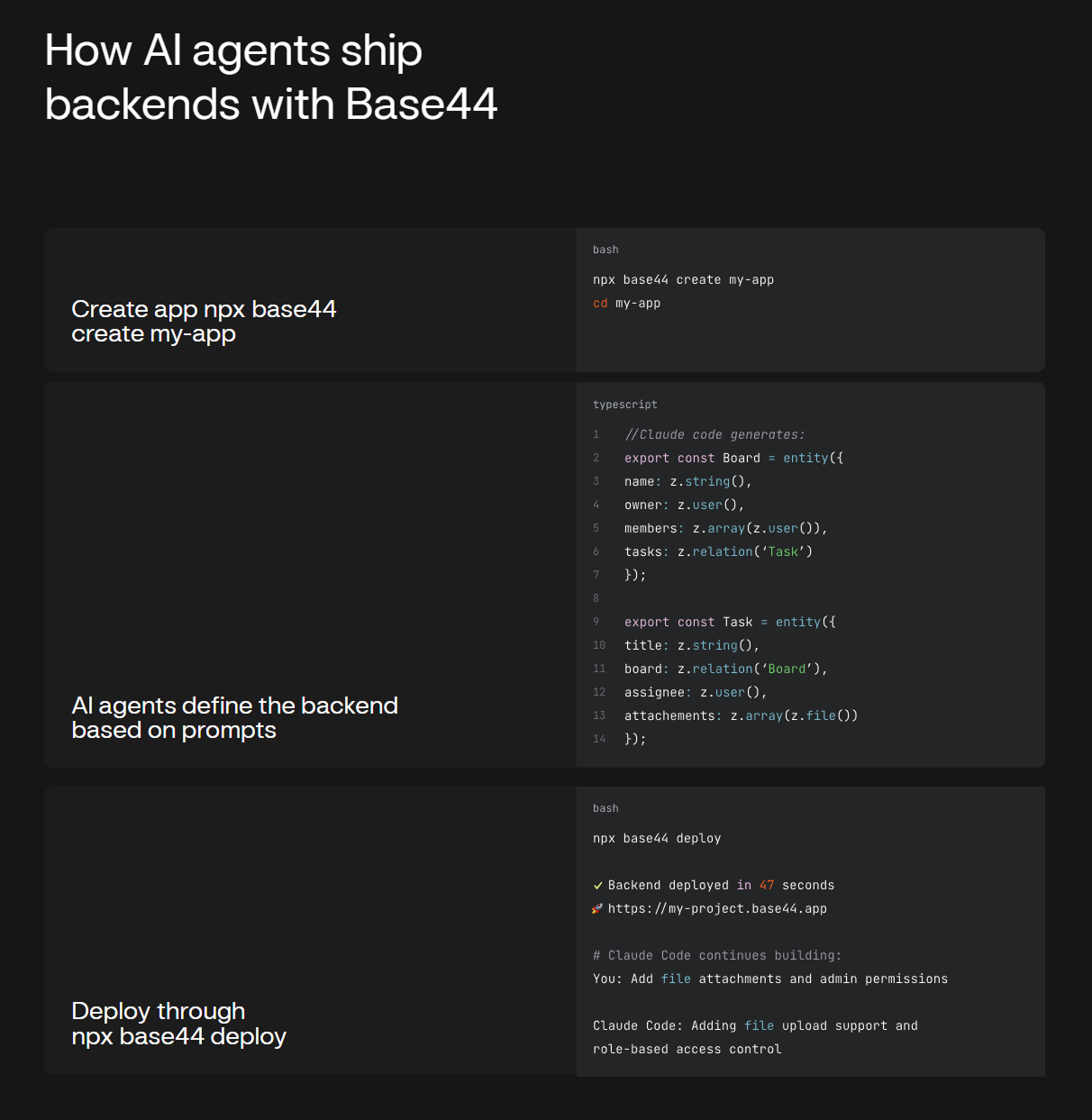
We use two key tools for this:
- Docker: We use Docker to package our applications and all their dependencies into a lightweight, portable “container.” Think of it as a standardized shipping container for code. It ensures that an application runs the same way everywhere, from a developer’s laptop to our production servers.
- Kubernetes: With hundreds of containers running, we need a powerful system to manage them. Kubernetes is our container orchestrator. It automates the deployment, scaling, healing, and networking of our containers. If a container fails, Kubernetes automatically replaces it. If traffic spikes, Kubernetes automatically scales up the number of containers. This provides immense resilience for the Base44.com backend.
Strategies for Maximum Uptime and System Reliability
Our users depend on Base44.com to be available around the clock. Ensuring maximum uptime is a non-negotiable goal, and we engineer our backend for extreme reliability. We achieve this through a multi-faceted approach where no single component failure can take down the entire system.
- Total Redundancy: Every critical component of our infrastructure, from load balancers to databases, has a redundant backup running in parallel. There is no single point of failure.
- Automated Failover: Our systems constantly monitor the health of all components. If an issue is detected in a primary system, traffic is automatically and seamlessly rerouted to its redundant counterpart without human intervention.
- Graceful Degradation: We design our system so that if a non-essential service (like a recommendation engine) fails, the core functionality of the platform remains fully operational for the user.
- Chaos Engineering: We proactively inject failures into our pre-production environments to test our system’s resilience. This practice helps us find and fix weaknesses before they can impact our users.
Scaling the Backend to Handle Peak Demand
The Base44.com backend is engineered to perform flawlessly, whether we have one hundred users or one million. We handle fluctuating demand through a dynamic scaling strategy that automatically adjusts our resources to match the current load.
Our primary method is horizontal scaling. Thanks to our microservices architecture and Kubernetes, we can instantly add more server instances for any service that is under heavy load. When a marketing campaign goes viral or we experience a seasonal traffic surge, our system automatically adds more containers to handle the demand. When the traffic subsides, it scales back down to conserve resources. This elasticity ensures a consistently fast experience for all users while maintaining cost-efficiency.
Performance Tuning and Advanced Caching Layers
Delivering a snappy, responsive experience is core to our backend development philosophy. Beyond writing efficient code, we achieve this through an aggressive, multi-layered caching strategy. Caching involves storing frequently accessed data in a location that is faster to retrieve than the original source.
Our caching layers include:
- In-Memory Caching (Redis): For data that needs to be accessed in microseconds, such as user sessions or API rate limits, we use a high-speed in-memory cache.
- Database Query Caching: We cache the results of common and computationally expensive database queries, preventing the database from doing the same work over and over again.
- Content Delivery Network (CDN): Static assets like images and videos are cached on servers around the globe, physically closer to our users, which dramatically reduces load times.
This comprehensive caching system significantly reduces the load on our core services and databases, ensuring the entire Base44.com backend remains fast and responsive.
A Deep Dive into Our Backend Security Measures
Protecting our users and their data is the single most important responsibility of the Base44.com backend team. We employ a “defense in depth” strategy, implementing multiple layers of security controls across our entire technology stack. Security is not a feature but a prerequisite for everything we build. Our approach includes rigorous code reviews, automated security scanning in our CI/CD pipeline, strict access control policies based on the principle of least privilege, and regular third-party penetration tests to identify and remediate potential vulnerabilities. We are relentlessly vigilant in securing every aspect of our server-side logic and infrastructure.
Protecting User Data with End-to-End Encryption
A cornerstone of our security posture is our commitment to comprehensive encryption. We ensure that user data is protected at all times, whether it is moving across the internet or stored in our systems.
- Encryption in Transit: All communication between your device and the Base44.com backend is encrypted using industry-standard TLS (Transport Layer Security). This prevents eavesdropping and ensures data cannot be intercepted as it travels over the network. All internal communication between our microservices is also encrypted.
- Encryption at Rest: All user data stored within our databases, object storage, and backups is fully encrypted. This means that even in the unlikely event of a physical breach of our data centers, the underlying data would be rendered unreadable and useless to an attacker.
Real-Time Monitoring, Logging, and Alerting Systems
We cannot fix what we cannot see. To maintain the health and performance of the Base44.com backend, we have a comprehensive observability platform that gives us deep insight into our systems in real-time. This platform is built on three key pillars:
- Monitoring: We collect thousands of performance metrics every second from every part of our infrastructure. These metrics, such as CPU utilization, API response times, and error rates, are visualized on live dashboards, giving our engineers an instant health check of the entire system.
- Logging: Every action and event within our backend generates a log entry. We centralize these logs from all our microservices into a single, searchable system. This allows us to trace a user’s request across multiple services to rapidly diagnose and debug issues.
- Alerting: We have an automated alerting system that constantly watches our key metrics. If any metric crosses a predefined threshold indicating a potential problem, the system instantly notifies the on-call engineering team, enabling us to respond proactively, often before users are even aware of an issue.
Key Technical Challenges and How We Solved Them
Building a large-scale backend is a journey of solving complex technical puzzles. Our experience has taught us how to overcome significant challenges with innovative and robust solutions. Here are a few examples of problems we have faced and the strategies we developed to solve them.
| Challenge | Our Solution |
|---|---|
| Zero-Downtime Deployments | We implemented a Blue-Green deployment strategy. This involves running two identical production environments. We deploy updates to the inactive (Green) environment, and once it is fully tested, we switch the router to send all live traffic to it, making it the new active (Blue) environment. This achieves updates with zero interruption to users. |
| Data Consistency Across Microservices | To handle transactions that span multiple independent services, we adopted the Saga pattern. This event-based approach ensures that if any step in a multi-service operation fails, a series of compensating actions are triggered to revert the changes, maintaining data consistency across the entire system. |
| Preventing Cascading Failures | We implemented the Circuit Breaker pattern in our API integration layer. If a downstream service starts to fail or respond slowly, the circuit breaker “trips” and stops sending requests to it for a period, preventing a single failing service from causing a chain reaction that takes down the entire application. |
The Future Roadmap for the Base44.com Backend
We are incredibly proud of the robust, scalable, and secure backend we have built, but we are never finished. Technology evolves, and so do we. Our roadmap is filled with exciting challenges and opportunities to make the Base44.com backend even more powerful and efficient. We are actively exploring and investing in several key areas for the future:
- Advanced AI/ML Integration: We are working to embed machine learning models deeper into our core server-side logic to provide smarter, more personalized user experiences.
- Serverless Architectures: We are expanding our use of serverless and function-as-a-service (FaaS) platforms to further reduce operational overhead and achieve even greater cost-efficiency and scalability.
- Event-Driven Architecture Enhancements: We are evolving towards a more reactive and asynchronous system by strengthening our event-driven architecture, enabling faster and more decoupled communication between services.
The journey of building a world-class backend is ongoing. If you are passionate about solving complex problems and building the technology of tomorrow, we invite you to join our team and help us shape the future of Base44.com.
Frequently Asked Questions
What are the core principles of Base44.com’s backend philosophy?
Base44.com’s backend is guided by several key principles: prioritizing performance as a critical feature, integrating security by design from the ground up, building systems for scalability, favoring simplicity over complexity in code and architecture, and automating everything possible to enhance efficiency and reduce errors.
What is Base44.com’s approach to database management?
They use a hybrid model called “polyglot persistence,” which involves using multiple database technologies for different purposes. They use SQL (PostgreSQL) for core transactional data that requires consistency and NoSQL databases (Redis and MongoDB) for high-speed caching, session management, and handling unstructured data.
How does Base44.com handle scalability and peak user demand?
The platform uses horizontal scaling within its microservices architecture. Managed by Kubernetes, the system automatically adds more server instances (containers) for services under heavy load. When traffic subsides, it scales back down, ensuring a fast experience while remaining cost-efficient.
What are the key security measures used to protect user data?
Base44.com employs a “defense in depth” strategy. A cornerstone of this is end-to-end encryption, which includes encrypting data in transit (using TLS) between the user and the backend, and encrypting data at rest (within databases and backups) to protect it from unauthorized access.
How are microservices used in the Base44.com backend architecture?
The backend is built as a collection of small, independent microservices, with each service responsible for a specific business function (e.g., authentication). This architecture allows for agility in development, improves fault isolation so one service failure doesn’t affect the whole system, and enables teams to use the best technology for each task.